


Sold out New
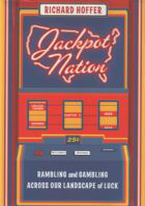
Jackpot Nation
$24.95
Estimating that Americans bet somewhere in the neighborhood of $80 billion a year, Hoffer, a senior writer for Sports Illustrated, wandered across the U.S. showing us how we gamble, why we gamble, and why the biggest opponents of gambling are now the biggest fans. He visits trade shows, hangs around underground poker games, hustles for a side of bacon in a Minnesota bar, discusses expansion plans with a tribal chief, and looks at every angle of chance taking. 241 pgs hardcover, 2007
Out of stock
This product is currently sold out.
No worries! Enter your email, and we'll let you know as soon as it's back in stock.
Description
Estimating that Americans bet somewhere in the neighborhood of $80 billion a year, Hoffer, a senior writer for Sports Illustrated, wandered across the U.S. showing us how we gamble, why we gamble, and why the biggest opponents of gambling are now the biggest fans. He visits trade shows, hangs around underground poker games, hustles for a side of bacon in a Minnesota bar, discusses expansion plans with a tribal chief, and looks at every angle of chance taking. 241 pgs hardcover, 2007
Additional information
| Weight | 0.5 lbs |
|---|
Shipping & Delivery
- Fast Processing: In-stock orders placed by 1:00pm PT ship within 2 business days. Our crew ships Monday–Friday.
- Custom & Special Orders: Production times vary. See the description above for specific lead times. Rules and transit times apply once production is complete.
- Reliable Carriers: We ship via USPS and UPS to ensure your gear arrives safely.
- Estimated Delivery (U.S.): Generally 3–7 business days for the contiguous states; 4–28 days for AK, HI, and territories.
- Full Details: For international rates, customs info, and specific shipping claims, view our full Shipping Information page.
- Returns: Easy returns for 30 days on new, unused stock products. Check our Returns & Refunds Policy for eligibility and instructions.
Related products

Sold out New
All Against The Law
Subtitled "The Criminal Activities of the Depression Era Bank Robbers, Mafia, FBI, Politicians, & Cops". Here for the first time is the complete story of the careers and lives of the four successive Public Enemies Number One who were the most dangerous machine-gun toting Midwestern bank robbers of the early Depression years - John Dillinger, Baby Face Nelson, Pretty Boy Floyd and Alvin Karpis with the Barker brothers. Besides being complete this presentation is wholly different from previous histories because for the first time the newspaper article accounts of these gangsters' activities are included. These were written by reporters from interviews of the eyewitnesses at these events, police and detective descriptions of the handling and findings of their investigations, and the trial testimonies of both the criminal cohorts and also the people who harbored these killers during their long fugitive manhunts. These facts were merged with the FBI agents' internal reports sent to Washington Headquarters that frequently admitted or confirmed their misconduct, as well as the many other documents used by previous crime historians. All this information combines to present the first complete timeline of these criminals' actions and personal lives as each fugitive alternated between hiding in a safe haven and staying on the run often just ahead of determined lawmen. Just as a movie is made up of many individual pictures that are flashed one after the other to produce the action, the many individual facts collected about each of these incidents create a dramatic step-by-step flow that produces an incredibly exciting and fast-moving adventure story. Interspersed throughout these Public Enemies Number One manhunts is the transformation of the Federal Bureau of Investigation from an accounting department of government money into a national police and detective agency. This is by far the most penetrating story of how J. Edgar Hoover took this group of politically-appointed accountants and attorneys, who by law could not carry guns or make arrests, and turned them into a full-fledged criminal detective agency. Hoover's leadership of the FBI has been discredited by numerous previous scholars, but this book goes much further in presenting how poorly-trained the agents were in police and detective procedure, the lack of respect they had for individual liberties and rights and their total disregard for the safety and well-being of the civilians who unintentionally appeared in their paths. Previous historians have usually described the actions of Hoover's FBI as like Keystone Cops or repeatedly referred to agents' actions as "inexplicable." But Hoover's agents' behavior was the direct byproduct of their Director's leadership and training procedures. After the reader learns the capabilities and values of Hoover's agents, their actions are neither funny nor baffling but instead very predictable. As each confrontation develops, the reader can sense how the situation can go terribly wrong as these courageous but ill-prepared early agents headed into what would likely become another failed raid or else produce disastrous results for the lawmen or innocent civilian bystanders caught up in the lines of fire. The mismatch between the skills of Hoover's early agents and the killers they went after could not have been more stark. These untrained agents went after the most aggressive and dangerous killers in history. These were not the typical variety of criminal who tries to escape when pursued by the police. Whenever these killers started to feel trapped or pressured, they would turn about face and run on foot out in the open, or whirl their car around as they floored the accelerator, charging their pursuers while blasting away with machine-guns. All this aggressive determination made Dillinger, Nelson, Floyd, and Karpis and the Barker brothers dreadfully successful at killing more policemen and FBI agents than any other American outlaws. Index 328 Pgs. 2013
Sold out New
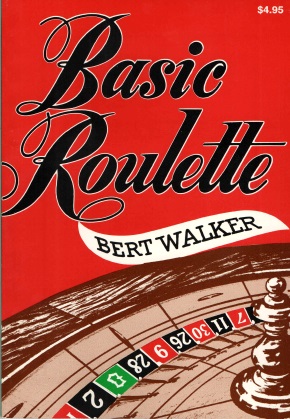
Basic Roulette
This primer advises the novice on the fundamental rules and methods of play. Geared to the American wheel (36 numbers - zero and double zero). 80 Pgs.1982
- Preface
- Introduction
- The Object of The Game
- Two Fundamental Fractions
- Wagers And Payoffs
- Compound Wagers
- Multiple Wagers
- A Simple Formula
- Getting In And Out Of The Game
- Buying In And Cashing Out
- Meeting Uncertainty For The First Time
- The Concept Of Randomness
- A Question For Mathematicians
- Two Kinds Of Game
- A Simple Concept
- The Formula Statement Of An Idea
- A Four-Event Division
- Choices And Chances
- Martingale And Anti-Martingale
- Building A Progression
- The Available Options
- Making The Decisio
- Some Final Considerations
- Theory Into Practice
- Reducing The Game
- The Conventional Layout
- Two Reasons For Dispersion of Numbers
- The Big Switch
- The Basic OrganizationThe Columns Modified
- Three Events – Spilt Sectors
- Four Events – Restricted Distribution
- A Final Word
- The Sample Runs
Sold out New
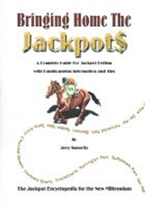
Bringing Home The Jackpots: Jackpot Betting With Handicapping
The author, (who previously wrote 'Out of the Red, Into the Black', a respected work on money management techniques), concentrates on three exotic jackpot bets: Pick 4, Pick 6, and Superperfecta. He tells you when the exotic is bettable (the pool must reach a certain level) because the potential reward has to constitute the risk. He also tells you how to play and how much to invest along with the mathematics involved in the wager. The book provides tables, charts, options in buying combinations and, presents 'matrixe', which offer examples and categories of horses to be used in these often expensive tickets. Some of the author’s advice includes avoiding horses without early speed, especially favorites, and avoiding small betting fields while eliminating bad jockeys and trainers. He offers seven betting angles to help the player hone his skills in exotic betting situations. 71 Pages Paperbound 1999
Sold out New
Sold out New
College Basketball Wagering To Win
A how-to book for bettors who are willing to spend some time handicapping to apply the author's systematic handicapping and wagering process. Explains how college basketball wagering works, the key ways to gain an wagering advantage, a step-by-step approach for handicapping games and tips for determining how much to wager. 145 Pgs. 2005
Sold out New
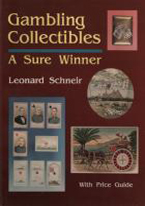
Gambling Collectibles
Gambling, simply stated, is as American as baseball, hot dogs, and apple pie. Despite the best efforts of our Puritan fore-bearers, America has, throughout its history, been a country of rebels and gamblers. The games - faro, poker, keno, hazard, roulette, and others, have produced objects that are highly collectible and valued by a growing number of aficionados. This wonderful new book explores the world of gambling collectibles in a way that will inform and amuse both the novice and the established collector. A myriad of gambling items are illustrated in over 400 full-color photographs. Included are some that are very rare and some that are not, but all of them are exceedingly attractive. They have about them an aura of romance and intrigue. In addition there is substantial text, helping the collector to put the items in a historical context as well as giving very practical information about building a collection.160 Pgs. 1997
New
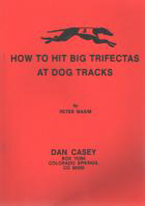
How To Hit Big Trifectas At Dog Tracks
Here's a book for the exotics bettor who wants a big payoff. Focus is on marking your program properly, what to do when you spot 'shippers', why maidens are treacherous, identifying class dog and running styles, importance of recent form and the 'best box' dog. This is a handicapping style book and not a book about combining numbers or watching toteboards. 48 Pgs.
Sold out New
When Capone’s Mob Murdered Roger Touhy
Subtitled "The Strange Case of Touhy, Jake the Barber and the Kidnapping That Never Happened'. When Prohibition ruled America in the 1920's, it produced a lawless decade and lawless citizens. A mob boss like Al Capone became not only the era's leading bootlegger but also a pioneer and kingpin in the union extortion racket, a golden source of easy money and underworld power. But there was another major crime figure in the windy city as well; a gangster who emerged from the poverty-drenched Irish slum section in Chicago known as the Valley. His name was Roger Touhy, the son of an honest Chicago policeman and the youngest of the six so-called "Terrible Touhy" brothers. Together the brothers ruled over a small but strong criminal empire on the city's outskirts, manufacturing and distributing beer, running unions and supporting their war against Capone's criminal syndicate through a series of widespread and lucrative robberies of the U.S. mail. This is the story of Roger Touhy's turbulent life. Bibliography Photographs 267 Pgs. 2001 Hardcover