


Sold out New
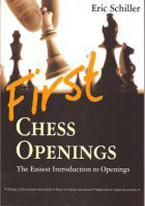


First Chess Openings
$12.95
This great beginning book shows players how to confidently start out a chess game with solid near-foolproof openings. Easy-to-read and targeted to novice and new chess player, the oversized format is filled with large diagrams, clear explanations, and ideas and concepts that are easy for new players. 160 pgs, paperback, 2005
Out of stock
This product is currently sold out.
No worries! Enter your email, and we'll let you know as soon as it's back in stock.
Description
This great beginning book shows players how to confidently start out a chess game with solid near-foolproof openings. Easy-to-read and targeted to novice and new chess player, the oversized format is filled with large diagrams, clear explanations, and ideas and concepts that are easy for new players. 160 pgs, paperback, 2005
Additional information
| Weight | 0.5 lbs |
|---|
Shipping & Delivery
- Fast Processing: In-stock orders placed by 1:00pm PT ship within 2 business days. Our crew ships Monday–Friday.
- Custom & Special Orders: Production times vary. See the description above for specific lead times. Rules and transit times apply once production is complete.
- Reliable Carriers: We ship via USPS and UPS to ensure your gear arrives safely.
- Estimated Delivery (U.S.): Generally 3–7 business days for the contiguous states; 4–28 days for AK, HI, and territories.
- Full Details: For international rates, customs info, and specific shipping claims, view our full Shipping Information page.
- Returns: Easy returns for 30 days on new, unused stock products. Check our Returns & Refunds Policy for eligibility and instructions.
Related products
New
25 Articles By Fred Brenner
Articles from a respected greyhound veteran covering such areas as marking your program; betting trifecta boxes; quinnelas; reading the toteboard; overemphasizing front-runners; pace; formula methods; post and style; progressive betting dangers; the trouble factor; overrated time factor; understanding grade changes; weight; the D race. 25 pages, paperbound. No date.

New
Advanced Handicapping Secondary Marks
Understanding how to mark the program will make a difference between losing and winning. The suggestions of how to mark your program in this book refers to any mark to help you correctly make a wagering decision. Casey covers the middle-box break problem dog; class dog gone bad; identifying a 'checker'; an overbet dog; double dropdown dogs. 21 pages, paperbound.

Sold out New
All Against The Law
Subtitled "The Criminal Activities of the Depression Era Bank Robbers, Mafia, FBI, Politicians, & Cops". Here for the first time is the complete story of the careers and lives of the four successive Public Enemies Number One who were the most dangerous machine-gun toting Midwestern bank robbers of the early Depression years - John Dillinger, Baby Face Nelson, Pretty Boy Floyd and Alvin Karpis with the Barker brothers. Besides being complete this presentation is wholly different from previous histories because for the first time the newspaper article accounts of these gangsters' activities are included. These were written by reporters from interviews of the eyewitnesses at these events, police and detective descriptions of the handling and findings of their investigations, and the trial testimonies of both the criminal cohorts and also the people who harbored these killers during their long fugitive manhunts. These facts were merged with the FBI agents' internal reports sent to Washington Headquarters that frequently admitted or confirmed their misconduct, as well as the many other documents used by previous crime historians. All this information combines to present the first complete timeline of these criminals' actions and personal lives as each fugitive alternated between hiding in a safe haven and staying on the run often just ahead of determined lawmen. Just as a movie is made up of many individual pictures that are flashed one after the other to produce the action, the many individual facts collected about each of these incidents create a dramatic step-by-step flow that produces an incredibly exciting and fast-moving adventure story. Interspersed throughout these Public Enemies Number One manhunts is the transformation of the Federal Bureau of Investigation from an accounting department of government money into a national police and detective agency. This is by far the most penetrating story of how J. Edgar Hoover took this group of politically-appointed accountants and attorneys, who by law could not carry guns or make arrests, and turned them into a full-fledged criminal detective agency. Hoover's leadership of the FBI has been discredited by numerous previous scholars, but this book goes much further in presenting how poorly-trained the agents were in police and detective procedure, the lack of respect they had for individual liberties and rights and their total disregard for the safety and well-being of the civilians who unintentionally appeared in their paths. Previous historians have usually described the actions of Hoover's FBI as like Keystone Cops or repeatedly referred to agents' actions as "inexplicable." But Hoover's agents' behavior was the direct byproduct of their Director's leadership and training procedures. After the reader learns the capabilities and values of Hoover's agents, their actions are neither funny nor baffling but instead very predictable. As each confrontation develops, the reader can sense how the situation can go terribly wrong as these courageous but ill-prepared early agents headed into what would likely become another failed raid or else produce disastrous results for the lawmen or innocent civilian bystanders caught up in the lines of fire. The mismatch between the skills of Hoover's early agents and the killers they went after could not have been more stark. These untrained agents went after the most aggressive and dangerous killers in history. These were not the typical variety of criminal who tries to escape when pursued by the police. Whenever these killers started to feel trapped or pressured, they would turn about face and run on foot out in the open, or whirl their car around as they floored the accelerator, charging their pursuers while blasting away with machine-guns. All this aggressive determination made Dillinger, Nelson, Floyd, and Karpis and the Barker brothers dreadfully successful at killing more policemen and FBI agents than any other American outlaws. Index 328 Pgs. 2013

Sold out New
Beyer On Speed: New Strategies For Racetrack Betting
This Beyer classic shows how to make speed the focal point of an effective strategy for racetrack betting. It explains how to relate the numbers to other important factors such as pace and track bias and reveals optimal uses of the figures based on computer analysis of more than 10,000 races performed by the Daily Racing Form exclusively for this book. 238 Pgs.1993
Table of Contents
- The Value of Speed Figures
- Probabilities and Patterns
- How Was the Figure Earned?
- How Will He Run Today?
- The Mathematics of Pace
- Turf Racing: Lessons from Two Continents
- Exotic Betting Strategy
- A Week in Las Vegas
Sold out New
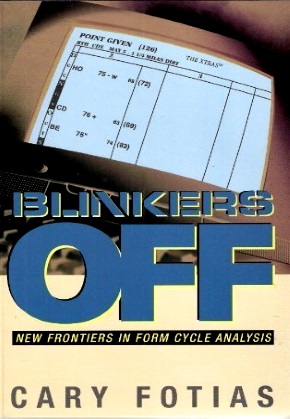
Blinkers Off
How DOES one learn how to identify a well-condition horse? That's the key. Fotias is the teacher: the subject is form cycle analysis. That factor AND money management are the one-two punch separating winners from losers in the long run. For those who believe pace, deceleration, velocity, feet per second, and ground loss are vital factors in handicapping a race, there's a gold mine of information awaiting you. Fotias believes it is crucial to examine each horse's last three years of performances when the opportunity exists. He adjusts his numbers for factors like wind, weight, track configuration and track variants; what most intelligent, dedicated players have sought for years. The book explores the dozen important variables handicappers should consider for every starter in a race since each has “ a certain amount of energy available to distribute” in the event. Those factors are: a horse's particular running style, the pace demand of the race, distance, surface, bias, the jockey, trainer, weight, post position, final time ability, racing luck, and the horse's current condition. 195 Pages Paperbound 2002
Sold out New
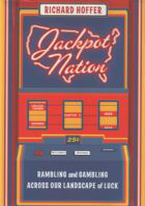
Jackpot Nation
Estimating that Americans bet somewhere in the neighborhood of $80 billion a year, Hoffer, a senior writer for Sports Illustrated, wandered across the U.S. showing us how we gamble, why we gamble, and why the biggest opponents of gambling are now the biggest fans. He visits trade shows, hangs around underground poker games, hustles for a side of bacon in a Minnesota bar, discusses expansion plans with a tribal chief, and looks at every angle of chance taking. 241 pgs hardcover, 2007

Sold out New
New
Super System 2: New Edition!
The original Super System by Doyle Brunson is the single most influential book ever written about the game of poker. Now, Super System 2 pushes the envelope further, expanding on the original with new games, new strategies, and new experts, including Crandell Addington, Lyle Berman, Johnny Chan, Jennifer Harman, Daniel Negreanu and Steve Zolotow. This is a brand new book-not an update. The book covers the essential strategies and advanced play on the most popular games played today - No Limit Hold'em, Limit Hold'em, 7-card Stud, 7-card Stud 8 or Better, 7 Stud High-Low, No-Limit Omaha, Omaha 8 or Better, Limit Low-ball Draw, High Draw Poker, Chinese Poker and Triple Draw Low-ball. Also includes important online poker and poker psychology. 699 Pgs. 2009